
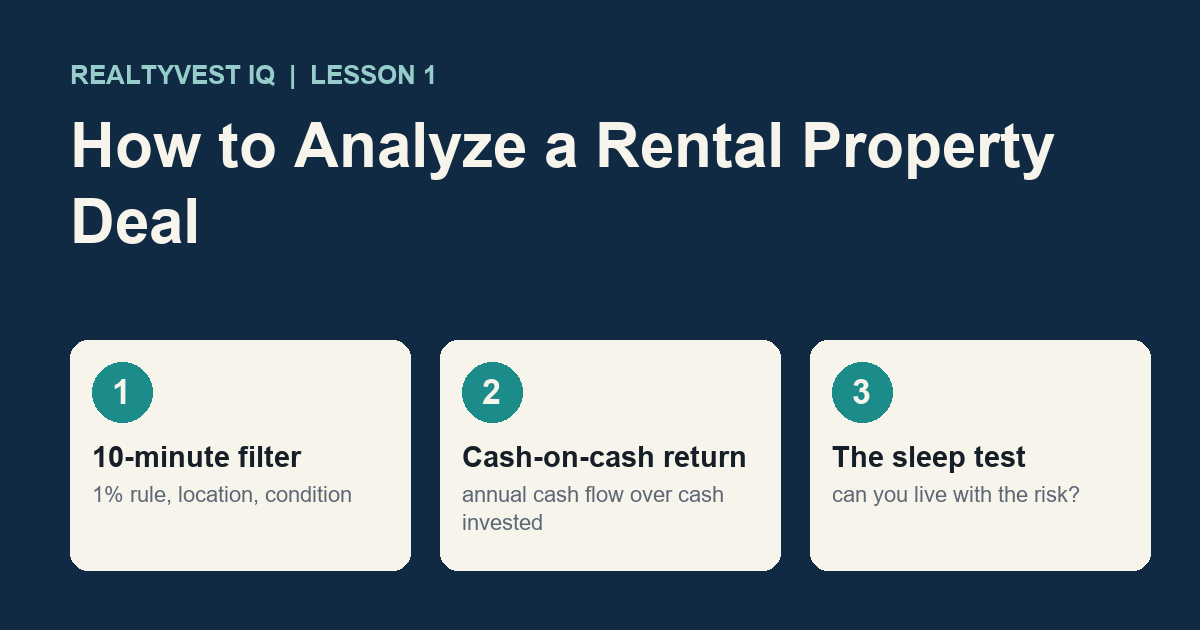
By the end of this lesson, you will know how to analyze a rental property deal with a simple framework and know exactly what to do next to move forward. We have all been there. You find a potential property, you start running the numbers, and suddenly you are drowning in spreadsheets and what if scenarios. You read about cap rates, cash flow, and return on investment until your head spins, and in the end, you do nothing. This is analysis paralysis, and it is the biggest reason most people never buy their first investment property. The truth is, you do not need to be an expert to spot a good deal. You just need a process.
What It Is
Analysis paralysis is the state of overthinking a decision to the point where no action is taken. In real estate, it means you spend so much time analyzing a potential deal that you never make an offer. It happens when you try to eliminate every possible risk or find a perfect property that does not exist. This is not a sign that you are being careful. It is a sign that your process is broken. A good process gives you enough information to make a confident decision, not enough information to guarantee a perfect outcome. The goal of analyzing a deal is to answer one question: Is this deal likely to work, and is it worth my time to investigate further? If you can not answer that question with a yes or no within a set period, your process is too complex.
Why It Matters
Every month you wait to buy your first property is a month you are not building equity, not generating cash flow, and not gaining experience. Real estate investing is a learn by doing business. You will learn more from owning one property for six months than you will from reading a hundred articles. Analysis paralysis keeps you stuck in the learning phase forever, watching from the sidelines while others are in the game. The cost of inaction is lost time and missed opportunity. A simple, repeatable process allows you to move quickly. It helps you filter out bad deals fast and focus your energy on the few that have real potential. This is how you build momentum. Momentum is more important than perfection.
How to Analyze a Rental Property Deal in Three Steps
Here is a three step process to cut through the noise and make a decision.
Step 1: The 10-Minute Initial Filter
Before you look at detailed calculations, do a quick sanity check. This screen is designed to filter out obviously bad deals and save you hours of work. Look for three things:
- The 1% Rule: Does the monthly rent potential equal at least 1% of the purchase price? For example, on a $200,000 property, can you realistically charge $2,000 per month in rent? This is a basic screen for cash flow potential, not a guarantee of a good deal.
- Location: Is the property in a neighborhood where people actually want to live? Are there signs of a healthy rental market, like low vacancy rates and a mix of homeowners and renters? You can find this information by calling a local property manager or looking at online rental listings.
- Condition: Is the property structurally sound? Does it need a full gut renovation or just cosmetic updates? A property that needs a new roof and foundation is a different project than one that needs new paint and carpet. Be honest about your budget and skills for repairs.
If a deal fails any one of these three filters, set it aside. Do not waste more time on it.
Step 2: The Key Metric Calculation
If a deal passes the initial filter, it is time to do the math. The single most important metric for a buy and hold property is cash-on-cash return. Cash-on-cash return tells you the annual cash flow you receive divided by the total cash you invested. Here is how to calculate it:
- Annual Cash Flow: (Monthly Rent – Monthly Mortgage Payment – Monthly Property Taxes – Monthly Insurance – Monthly Estimated Repairs and Vacancy) multiplied by 12.
- Total Cash Invested: Down Payment plus Closing Costs plus Initial Repairs.
- Cash-on-Cash Return: Annual Cash Flow divided by Total Cash Invested, multiplied by 100.
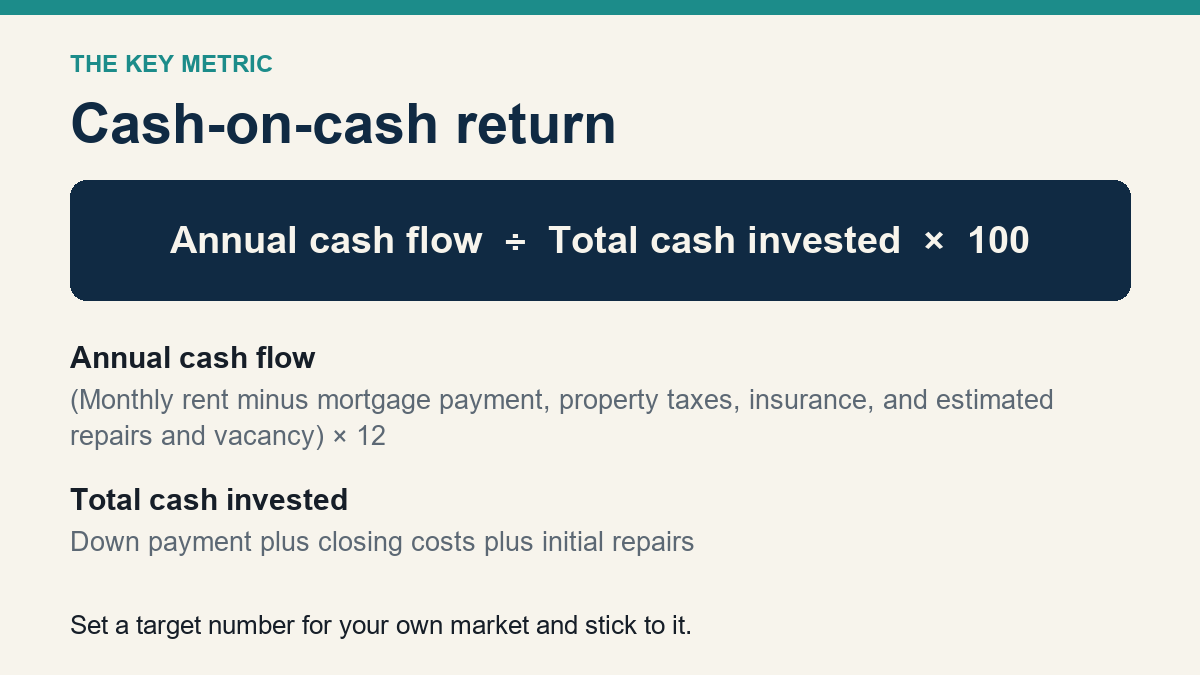
For example, an investor might look for a specific cash-on-cash return target based on their local market conditions. The key is to have a target number for your area and stick to it. This number forces you to make a decision based on facts, not feelings.
Step 3: The Sleep Test
After you have run the numbers, ask yourself one simple question: If I buy this property and the cash flow is exactly what I calculated, can I sleep at night? This question forces you to consider your risk tolerance. Are you comfortable with the potential repair costs? Can you handle a few months of vacancy if a tenant moves out? If the answer is yes, it is time to make an offer. If the answer is no, walk away. Do not try to fix the deal to make yourself feel better.
Real Results
Let us look at a worked example to see how this process works in practice. This is an example using round numbers to illustrate the method.
Example:
- Purchase Price: $200,000
- Down Payment (20%): $40,000
- Closing Costs: $5,000
- Estimated Repairs: $10,000
- Monthly Rent: $2,000
- Monthly Mortgage Payment (Principal and Interest): $955
- Monthly Property Taxes: $200
- Monthly Insurance: $100
- Monthly Repairs and Vacancy Fund: $150
Step 1 in the Example: The 10-Minute Filter
- 1% Rule: $2,000 divided by $200,000 equals 1%. Pass.
- Location: Assume this is a stable neighborhood with good rental demand. Pass.
- Condition: Assume the property needs cosmetic updates only. Pass.
Step 2 in the Example: The Key Metric Calculation
- Annual Cash Flow: ($2,000 minus $955 minus $200 minus $100 minus $150) multiplied by 12 equals $7,140.
- Total Cash Invested: $40,000 plus $5,000 plus $10,000 equals $55,000.
- Cash-on-Cash Return: $7,140 divided by $55,000, multiplied by 100 equals 13%.
This return meets the target for the example, so the deal moves to the final step.
Step 3 in the Example: The Sleep Test
You ask yourself if you can handle a $55,000 cash investment for a 13% return. If the answer is yes, you make an offer. The process is simple, repeatable, and leads to a decision.
Common Mistakes
The biggest mistake new investors make is trying to analyze every possible outcome. They create complex spreadsheets with dozens of variables, trying to predict the future with impossible accuracy. This is a recipe for paralysis. Your job is not to predict the future; it is to manage risk. A second mistake is ignoring your market. A deal that is a home run in one city might be a strikeout in another. The 1% rule and cash-on-cash return targets are not universal; they are local. You must know your market numbers. Finally, many investors wait for the perfect deal. There is no such thing. Every deal has flaws. The goal is to find a deal with good numbers and a manageable number of flaws. A good deal is one where you understand the risks and are comfortable with them.
Your Next Step
Analysis paralysis is not a sign that you need more information. It is a sign that you need a better process. By using a simple, three step framework, you can cut through the noise and make confident decisions. Your first deal is not about getting rich. It is about learning the business. The best way to learn is by doing. This week, take one concrete step: find a property listing online and run it through the 10-minute initial filter. See what you find. This small action will build the momentum you need to get off the sidelines and into the game. This is information, not financial, tax or legal advice, and the reader should talk to their own CPA, attorney or lender before acting.